


The Coalition of the Willing and the Ukrainian Conflict: Reassurance for Peace or Indirect Escalation?
September 5, 2025 Hour: 2:21 pm
🔗 Comparte este artículo
The Coalition of the Willing: A New Name for the Same Reality?
International history seems to have painfully repetitive cycles. The concept of the Coalition of the Willing brings to mind the illegal military intervention in Iraq in 2003, which was launched without the backing of the United Nations.
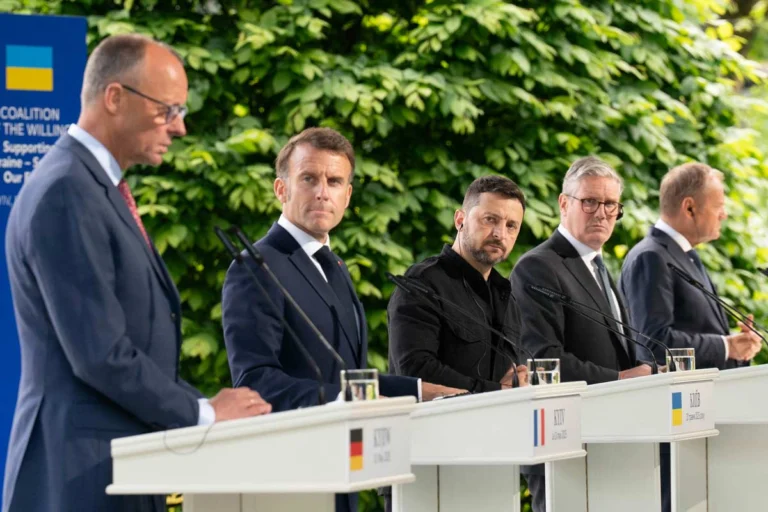
But today, at the September summit in Paris, it has re-emerged under a new narrative. French President Emmanuel Macron announced the formation of a new Coalition of the Willing, made up of 26 countries, with the goal of deploying troops or equipment in postwar Ukraine.
The mission is not for an attack, but as a “reassurance” to guarantee peace and stability. However, in the complex context of the conflict between Russia and Ukraine, the thin line between security and military escalation is alarming.
The New Coalition’s Mission: From War to Deterrence
This new Coalition of the Willing in Ukraine is clearly different from the 2003 initiative. First, its composition is distinct: it includes European powers like France and Germany, but without the traditional leading role of the United States, which represents a significant change in the architecture of international security.
While the official list of the 26 countries remains confidential to avoid alerting the Kremlin, journalistic sources suggest that, in addition to France and Germany, Poland, Italy, Spain, Canada and other allied European nations are included.
The stated mission of this coalition is to deter new Russian aggression after a potential ceasefire. Thus, the deployment of troops seeks to ensure stability, protect borders, and prevent the resumption of conflict by offering guarantees that NATO has avoided providing directly to prevent escalating the confrontation.
This move, described by Macron as a “reassurance” effort, constitutes a bold gamble with a security focus specific to Europe, which takes on direct responsibility for the peace of the continent.
The Latent Risk: Real Peace or a Pretext for Escalation?
The Russian reaction was immediate. The Kremlin harshly rejected the initiative, calling it a provocation and warning that any foreign military presence on Ukrainian soil will be considered a legitimate target.
This rejection reveals the main dilemma of the Coalition of the Willing: is it truly a strategy to pressure peace negotiations or a pretext to involve Western powers even more in the Ukrainian conflict?
Beyond the official discourse, the deployment of troops, even if only for “reassurance,” implies an undeniable risk of direct confrontation, as it involves armed forces operating within a sovereign, disputed territory.
From a critical progressive perspective, traditionally opposed to military intervention and meddling, this step must be analyzed with caution, questioning whether it provides a peaceful solution or instead fuels escalation.
Internal Divisions and Doubts About the Legitimacy of the Deployment
Although the Coalition of the Willing is projected as a solid alliance, internal differences exist among the participating countries. The levels of commitment are unequal, and internal political agendas also vary.
A key point is the response of public opinion in these nations, many of which might not support sending troops to a conflict zone that is called “postwar” but remains highly volatile.
Likewise, the absence of an explicit United Nations mandate strengthens criticism regarding the legality and morality of the deployment and gives rise to questions about the true interests behind this action.
From a socialist and leftist perspective, it is essential to question whether the coalition represents a sincere step toward a sustainable peace or if, on the contrary, it responds to the geopolitical interests of powers and the military industry seeking to contain Russian advancement.
Key Agreements from the Paris Summit and Ukraine’s Response
Among the main agreements are:
- Deployment of “reassurance” troops: The 26 nations involved have committed to sending forces or equipment to Ukraine once a ceasefire is established. Macron insisted that it will not be a combat force to confront Russia but a mission to prevent aggression and sustain peace.
- Solid military planning: Macron assured that the coalition is already developing detailed plans to formalize the operation and guarantee its effectiveness.
- Increased sanctions on Russia: In sync with the United States, the coalition agreed on the possibility of applying new sanctions if Moscow refuses to sit down for peace negotiations or continues its aggressive policy.
Volodymyr Zelenskyy’s Position
The Ukrainian president welcomed the commitments that were made:
- He considered the coalition a true diplomatic victory and a clear sign of international support.
- He expressed that the initiative will increase pressure on Russia to advance negotiations.
- However, he stressed that a direct meeting with Vladimir Putin is essential to end the conflict, although there have been no signs from the Kremlin in that regard so far.
The Future Is Uncertain: European Stability or Geopolitical Tinderbox?
Only time will tell if this Coalition of the Willing will be the pillar for lasting peace in Ukraine or the prelude to a dangerous escalation in Europe.
If the ceasefire is respected and the deployed forces effectively generate stability, we could be looking at a new regional security paradigm for Europe with less dependence on the United States.
But if the truce is broken and the troops are forced to defend themselves, we could face an unpredictable outcome and the resurgence of even greater tensions.
This initiative is, in short, a risky geopolitical experiment that reminds us of a maxim in foreign policy: good intentions rarely guarantee peaceful results.
Author: Silvana Solano
Source: TeleSur